Ian Fleming’s You
Only Live Twice (1964) is certainly one of the author’s most
brilliantly bizarre and offbeat pieces of work from a James Bond oeuvre which
was by that stage already rich with originality (see the short
story 'Quantum of Solace' [1960] and the novel The Spy Who Loved Me [1962]). The penultimate James
Bond novel incorporates travelogue, learned references to Japanese culture,
lists of deadly flora and fauna, a revenge tale, the beginnings of serial
killer fiction (a craze of the 1990s) and fine Gothic horror as well as being
the unfolding story of a dystopia on a Huxleyesque scale. It is a Brave
New World for Fleming in terms of writing territory and although it
might seem like it at times, it is not true that (unlike Aldous Huxley) Fleming
was on mescaline at the time of writing You Only Live Twice(!). At
the time of writing You Only Live Twice Fleming was sadly
literally dying from the admirable ailment of “having lived too much” (in
reality the Fleming family trait of a bad heart or “the iron crab” as Fleming
called it, was to blame) at the time he was writing this novel and so the
fascination with the theme of death and the general air of morbidity throughout
the proceedings really rings true from a man already painfully aware of his own
mortality. Somehow, Fleming sensed he was soon about to “shuffle off this
mortal coil” as Shakespeare so eloquently put it and so he must have sat down
at his golden typewriter at his house Goldeneye in Jamaica,
and forgetting the winter sun outside, drew inspiration from his impending
death. As it turned out, he was of course right – he sadly died in the early
hours of 12 August 1964 after having just the day before been made the Captain
of the Royal St. George’s Golf Club.

You Only Live Twice (1964): UK First Edition.
Although it
represents the final part of the Blofeld/SPECTRE Trilogy of James Bond novels
there is no typical Bondian world domination plot here (cf. the film version) but instead a
private estate run by a veritable mad hatter called Dr Guntram Shatterhand who
of course turns out to be none other than Bond’s aforementioned arch-enemy and
the murderer of his bride Tracy Bond in On Her Majesty’s Secret Service (1963).
SPECTRE it seems has went the way of the Dodo, which is more realistic than how
the evil organisation (and its leader Blofeld) kept coming back film after film (excepting Goldfinger [1964])
between 1962 and 1971 in the Eon Productions Bond film series. The Ernst Stavro
Blofeld of You Only Live Twice is a different animal (a mad
dog meets an Englishman; Fleming was certainly very clever in his themes!) to
what went before and here he can be seen as a veritable mad king (called King
Ernst I most likely) and a lunatic ready for the asylum. In English Criminal
Law there is in fact something called “the Henry VIII Syndrome” where the
defendant goes around lopping people’s heads off (just like Blofeld) as he
thinks he is King Henry VIII; it is therefore good grounds for a plea of
insanity with the inevitable result of hospitalisation in a mental hospital.
Henry VIII of course had two of his six wives beheaded, namely Ann Boleyn (by the sword) and Catherine Howard (by the axe). Blofeld also displays the madness that afflicted King George III for much of his reign (which lasted from 1760 to 1820). Blofeld shouts in
German much like the ranting and raving Adolf Hitler in the Führerbunker near
the end of World War II when the war was all but lost and he seems equally as
much out of touch with reality. Evidence for this comparison consists of the
fact that we are for instance told of "that lunatic Hitler scream"
from Blofeld in the Garden of Death at one point in the novel. One reads of
Nazis escaping to Argentina and Spain at the war’s end but perhaps a few
escaped to Japan too? It may be that that was what Fleming was pointing at –
that there was a diverse Nazi evil being spread throughout other third
countries as a result of such real post-war Nazi SS resettlement organisations
as Odessa or Spinne. For the very original idea of the Garden of Death it is possible that Fleming was inspired by the 1896 watercolour painting named 'The Garden of Death' by the Finnish symbolist painter Hugo Simberg (1873-1917):
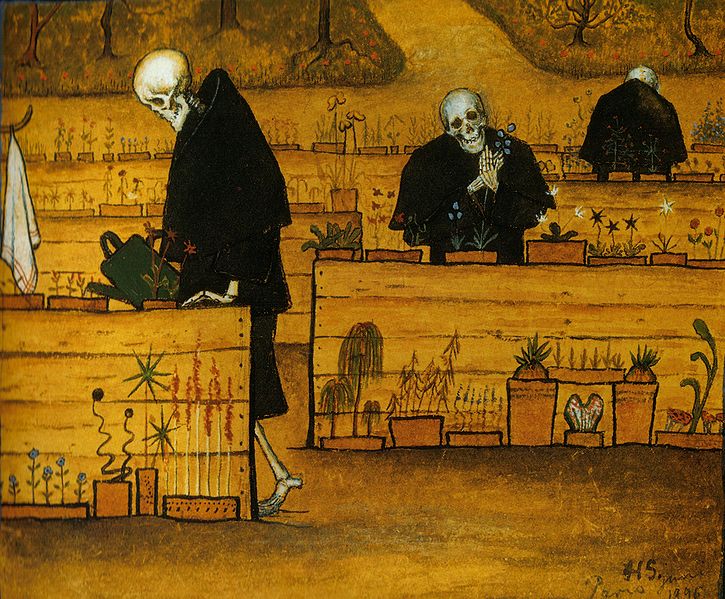
'The Garden of Death' (1896) by Hugo Simberg.
It is notable that Blofeld’s plan here is not to hijack a Vulcan bomber and its deadly cargo of two nuclear bombs for a grand ransom (Thunderball [1961]) or to use biological weapons against the United Kingdom (On Her Majesty's Secret Service) but merely to induce the notoriously suicide-prone native Japanese population to kill themselves in ever more eccentric fashion in a “garden of delights” populated by highly poisonous flora and fauna, piranha fish, scorpions, snakes and fumaroles. This garden is the locale where Blofeld goes utterly insane and indeed it is a veritable anti-Eden where the Fall of Man brought about by Adam and Eve’s quest for knowledge is all too evident. It is as if the imaginative horrors of a Brothers Grimm fairy tale or a novel by the Marquis de Sade have somehow come to life in the early 1960s with a little early Swinging Sixties hocus-pocus thrown in for good measure. Blofeld does his rounds of the garden in a full suit of armour as does his companion Bunt (with the grotesque addition of a bee-keeper’s hat) and Fleming seems to be making the point that Blofeld is trying to be a legitimate samurai warrior with all of the code of honour that implies though we the reader see he is woefully inadequate in this role and that he is a mere gaijin, common criminal and definite bounder. The madman Blofeld is nothing more than a mere shadow warrior playing at being a samurai warrior just like children play at being James Bond. Blofeld and Bunt even plan to eventually sell up from Japan and then take their ghastly “death show” on the road in other locations around the world such is their ultimate cruelty, depravity and deeply twisted inhumanity.
In You Only Live Twice there is
no world domination master plan but in its stead there is just the mad king
Blofeld lopping off people's heads with a samurai sword, years before the
serial killer fiction craze of the 1990s (which has of course continued on
until the present day) that Blofeld's plan to maximise Japanese suicides in his
Garden of Death is akin to. In this sense Blofeld can be seen as a forerunner
to that other madman in a Castle of Death, the serial killer ex-actor David
Dragonpol in John Gardner’s James Bond continuation novel Never
Send Flowers (1993) who lived in the aptly-named Scholss Drache
(‘Drache’ being German for ‘Dragon’ as well as Sir Hugo Drax’s real name in
Fleming’s Moonraker [1955]) in the Rhineland, Germany. Indeed,
there are many interesting connections between both Bond novels, though the
Fleming purist might blanch at the idea of Gardner’s off-beat
creation Dragonpol being compared to Fleming’s infamous arch-villain Blofeld!
Like Dragonpol with his assassination targets of the good and the great, Blofeld
attracts the suicidal Japanese seemingly for his own sick enjoyment and also
for the delectation of his squat and grotesque consort Fraulien Irma Bunt. Bunt
has the type of wardress face often associated with a Nazi death camp guard and
as she is German and of the right age that could well have been her occupation.
Fleming may well have drawn inspiration for Irma Bunt from some notorious
female Nazi concentration camp guards like Ilse Koch (1906-1967), who
eventually committed suicide in prison or ‘The Bitch of Buchenwald’ or
Irma Grese (1923-1945), whom the Press called ‘The Beast of Belsen’ during her
1945 ‘Belsen Trial’ for war crimes and whom the inmates also dubbed ‘The Hyena
of Auschwitz.’ Grese was found guilty at the trial and executed by hanging in 1945. In any event,
Fleming’s contemporaneous readers would have been aware of the allusion to
female Nazi wardresses Irma Bunt represented. Bunt (as described by Fleming) also looks a tad like
the convicted serial killer Rosemary West.

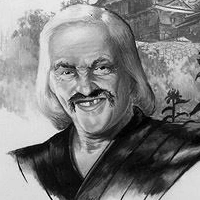
George Almond's painting of Ernst Stavro Blofeld in his Garden of Death in Fleming's
You Only Live Twice (1964).
Of course, Fleming’s
novel is as far away from the dire Roald Dahl-scripted 1967 film version as it
is possible to get. (Harold Jack Bloom also worked on the screenplay before Dahl was hired and he was credited with "additional story material" as Dahl used some of his ideas in his new script). As the producers Albert R. "Cubby" Broccoli and Harry Saltzman and director Lewis Gilbert were unable to
find a castle built near the sea on their recce to Japan (it turned out that the Japanese did not build castles near the sea due to the tsunami risk) they decided to move
almost completely away from the Fleming source novel by literally throwing it in the
wastepaper bin and starting over again with a topical Cold War Space Race plot. Meanwhile, the Fleming
purist can only hope that You Only Live Twice will at some
point in the future be filmed as a new chapter in Bond villainy where evil is
seen to have had no other point than glorying in said evil itself. That seems a
good theme for a Bond film that could sit very well along with the Bond film
villains Karl Stromberg and Hugo Drax (of the films The Spy Who Loved Me [1977] and Moonraker [1979] respectively)
who were not interested in money or extortion but rather in creating new worlds
in their own inherently evil image, just as it could be said Blofeld did
originally with his Garden of Death in Japan. Bunt makes the point in
conversation with Blofeld that the world has never seen the like of Blofeld’s
Garden of Death before and so too would have Stromberg and Drax had they been
interviewed about it following the success of their annihilator schemes. Ian
Fleming's other villainous creation Dr Julius No was of course also an influence
on the Bond film villains Stromberg and Drax and their nefarious schemes. Blofeld has
seemingly single-handedly turned the Godly garden and the Englishman’s dwelling
place of a summer day into a dark and grotesque “Disneyland of Death”. In
opposition to this perversion of the inherent sacredness of the garden is the
fact that the English county of Kent is known as "The Garden of
England" (cf. The Garden of Eden?) and this was of course on
the side of the angels and was a haunt of Ian Fleming's and was where the majority
of his third novel Moonraker was set. Moonraker featured
a duplicitous ex-Nazi called Sir Hugo Drax who is based in Kent near the White
Cliffs of Dover with his answer to Britain's defence, the “Moonraker” nuclear
rocket. The fact was surely not lost on Fleming that he chose this very
location given the Battle of Britain and the new British saviour weapon in the
arsenal called the the Spitfire aircraft (as well as defences
from ‘Operation Sealion’) that saved dear dependable old Blighty in her ‘Hour of Need’.
Blofeld selfishly wanted his Garden of Death to be a success just as
Stromberg’s wanted his own underwater civilisation at the expense of the rest
of the world or that Drax wanted to annihilate the Earth (in a Hiterian
Holocaust) and then populate it with a new Super Race of perfect physical
specimens of all races.
 You Only Live Twice (1964): US First Edition.
One can quite easily
see (in the Blofeld of the You Only Live Twice novel) the seeds of these truly
bizarre and barking-mad characters in some of the Bond villains of the Roger
Moore-era Bond films. In this sense, perhaps a bit of the You Only Live
Twice Blofeld has rubbed off on some of the cinematic Bond villains
that came in the years after Ian Fleming’s death where the screenwriters like
Roald Dahl, Tom Mankiewicz and Christopher Wood otherwise turned away from the
original Fleming Bond source material when it came to Bond villains and other
components. With all of this in mind, one also thinks of Richard Maibaum’s
original plot suggestion for The Spy Who Loved Me film to have
real-world terrorists blow up the world’s oil fields with stolen nuclear
submarines and watch the world burn just for the sheer hell of it. That would
have been as close to the Blofeld of You Only Live Twice novel
as the Bond films would likely have ever gotten. It was sad indeed that
Maibaum’s vision for something “completely different” (as the Monty
Python’s Flying Circus gang would have put it) never made it onto the
screen. The producer Albert R. “Cubby” Broccoli ruled out going ahead with
Maibaum’s script for The Spy Who Loved Me out as being too
overtly political for the James Bond film series, although he did like the
idea. Of course sections of the recent Skyfall was based at
least in part on events near the end of You Only Live Twice where
Bond is shot in the head and loses his memory, and for the Fleming enthusiast
that was surely a great thing to behold. Indeed, the hotly anticipated
release of the twenty-fourth James Bond film Spectre in
October 2015 gives the Fleming purist renewed hope that the criminally
neglected novel You Only Live Twice, with its mad king Blofeld and
his equally mad Garden of Death will finally make the transition from the
printed page to the cinema screen.

Liked this article? Then see the following related article on TBB:
Ian Fleming's "Thrilling" Inspiration for Roald Dahl's You Only Live Twice (1967) - http://thebondologistblog.blogspot.co.uk/2012/08/ian-flemings-thrilling-inspiration-for.html
TBB Article No. 22
© The Bondologist Blog, 2015.
