Showing posts with label Ian Fleming. Show all posts

Tuesday, 22 March 2016

Eleven Years Later: an Addendum to “The Dossier on Robert Markham” (first published in 007 Magazine, issue no. 47, October 2005, pp. 28-39)

Guest Article by Hank Reineke


In an August 1982 interview conducted by Raymond Benson (for Bondage, the magazine of the American James Bond Fan Club), author Kingsley Amis relates that he met James Bond creator Ian Fleming on only “a couple” of occasions.  If we take Amis at his word literally, this would mean there were at least two – and possibly only two – genuine meetings between the two men.  If this was the case, at least one (and perhaps both) of these encounters have been partly and properly documented.  On 19 July 1964, Fleming’s wife Ann wrote to Evelyn Waugh that “Kingsley Amis came to dinner.”  Referencing Amis’ as-yet-unpublished study The James Bond Dossier, the cynical Ann – never an admirer of Amis, the sardonic but celebrated author of Lucky Jim (1954) - continued, “I suspect he wrote of Ian to further his own sales, but it seemed a genuine admiration.”  Amis himself recalled an earlier, mostly passing, moment with Ian Fleming at a party, with a second meeting (“the other time”) having transpired when Fleming invited him to a “nice, quite expensive” lunch.  Amis had earlier sent Fleming his typescript of The James Bond Dossier to review prior to the book’s publication and this was, apparently, the main topic of conversation at their luncheon discussion.  I don’t think it’s entirely clear if this luncheon is the same one Ann references in her letter of 19 July 1964.  If it was Fleming would, of course, be dead within a month’s time of that second and final get-together.

In regards to Kingsley Amis’ role in working on the typescript of Fleming’s final James Bond novel The Man with the Golden Gun:  Well, there’s no doubt now that Amis did receive a remittance for his time and effort for working on the final typescript of that novel; Jon Gilbert, author of the masterful and exhaustive  Ian Fleming:  The Bibliography (2012) has revealed that on Christmas Eve 1964, Amis was issued a cheque for his work (amongst several other readers) in helping proof-edit the weak typescript of The Man with the Golden Gun.  It was also revealed that Fleming – due to exhaustion and poor health - was prepared to sign-off on the manuscript and leave it to others to shape into something publishable.  Gilbert notes that 596 proof copies of The Man with the Golden Gun were published; twenty-four of these copies were reserved for Fleming’s “literary heirs,” one of who was – to no one’s surprise – Kingsley Amis.  Gilbert also notes that it was most likely in July/August of 1964 that Cape finally called in Amis (who had already turned in his publication-ready draft of The James Bond Dossier to the publisher), to help tidy up the Fleming typescript as the author’s health had deteriorated so rapidly and unexpectedly.  But all evidence suggests the changes made by Amis and several others made privy to the typescript were all grammatical and/or minor and cosmetic in nature; no one involved had dared change the author’s intent or altered the storyline in any manner.  No matter what the fanciful conspiracy-theorists might suggest. 

The Man with the Golden Gun was published, posthumously, by Jonathan Cape in Britain on 1 April 1965.  As he had access to the typescript long before most others, Amis’ lengthy and not un-critical review of the final Fleming Bond novel (“M for Murder”) was published the following day, 2 April 1965 in the New Statesman.  As I mentioned in my lengthy essay on the history of Colonel Sun in the October 2005 issue of 007 Magazine, Amis had been somewhat disingenuous in not revealing his small role in the editing of the typescript that Fleming had left behind.  It hardly mattered though as his review was less than flattering in nature.

Jonathan Cape was quick to piggy-back pre-emptively on the publication of the decidedly weak tea, mostly bare-bones first draft manuscript that was The Man with the Golden Gun.  Amis’ The James Bond Dossier followed quickly, published by Cape in May of 1965, no doubt in part to burnish – and perhaps salvage - the critical reputation and legacy of the late great Ian Fleming whose hero had seemingly gone out on a low note.  I’ve never come across a first-edition copy of the Dossier that gives more than “Copyright 1965” as the proper date of publication; but the earliest reviews of the Amis book (all from the UK) date from the last month of May 1965.  Amis’ preface to his book is dated “May, 1964” which, if true, means the book languished in pre-publication status for nearly a year.  This would not be too surprising; it would have made perfect sense for Cape to hold back publication of The James Bond Dossier in spring of 1964.  The penultimate Fleming Bond novel, You Only Live Twice, a far superior work to the subsequent The Man with the Golden Gun, had only been published in March 1964 and was still enjoying strong sales.  Having the Amis book arrive so soon after would have not been a sensible marketing move and might have even proved detrimental to sales of You Only Live Twice at that particular time.


The lengthy delay in Amis turning in his original typescript of The James Bond Dossier in May of 1964 and the posthumous publication of The Man with the Golden Gun on 1 April 1965, allowed Amis to revisit the Dossier.  This left him free to weave in passing references to the now most recent James Bond novel as well as properly mourn and duly note Fleming’s passing in the book’s final chapter.  Regardless, there’s still not a lot of discussion or mention of The Man with the Golden Gun in the Dossier; I’d guess that most of the references to this disappointing final Fleming Bond were added only to complete the circle and give his own study a more contemporary sheen.

As for the myth of Kingsley Amis’ lone Bond continuation novel Colonel Sun having been conceived from Fleming’s notes?  In short, this is complete nonsense.  It was a totally original novel.  Amis has long maintained this was the case and I (nor anyone else) should have any reason to doubt it.  Despite Ann Fleming’s misgivings of her late husband’s very personal creation having been appropriated by another writer, it was clear from the beginning that Fleming’s publisher, Jonathan Cape, was not going to let James Bond get buried along with his creator.  Amis famously ended The James Bond Dossier with the sentence that Ian Fleming left behind “no heirs.” Perhaps not, but in their glowing review of his Dossier in the Times Literary Supplement (27 May 1965), that newspaper’s book critic disagreed: “No heirs?  Mr. Amis, his well-written, witty, expert dossier concluded, may choose to reconsider and take action.  Surely he is the man to conjure Lazarus from the grave.”


There’s little doubt that the editorial staff of Jonathan Cape were in agreement.  There was certainly any number of good reasons to carry on the literary series.  Bookshelves were deluged with James Bond copycat series, and one has to remember that Bondmania was at or near its zenith due to the successes of the film franchise:  Goldfinger was released in the UK in September 1964 and Thunderball was due out in December 1965.  So there was a lot of intellectual-property to protect and a not inconsiderable profit to lose in the abandonment of James Bond as a literary figure.  Coming on the heels of his well-received and thoughtful The James Bond Dossier (for Fleming’s own publisher, mind you), Amis had also won some favourable notices for his own recent maverick secret-agent novel The Anti-Death League (1966). Amis was, without question, the most likely of candidates to carry on the series.

There’s no doubt that Jonathan Cape was prepared to push on without Ian Fleming, who had passed away too soon at the age of 56 on 12 August 1964. In April 1967, Amis told the New York Times that Gildrose had already been thinking about the continuation project for some two years… so let’s say since the spring of 1965 which, as it happens, neatly coincides with the time of publication of both The Man with the Golden Gun and The James Bond Dossier.  The month following the publication of The James Bond Dossier (1965), Amis was married (29 June 1965) and immediately following went off to a “small drinks party at Jonathan Cape.” So discussion between Cape and Amis to (quietly) experiment with writing a continuation Bond had been hashed over casually amongst the two parties almost from the onset.  Negotiations likely turned more serious following the publication and favourable critical notices of the Dossier in the summer of 1965.


By the summer of 1965 the plans for James Bond’s return, for certain, were already in motion. On 12 August 1965 Amis had written to friends that he was to visit Greece in September 1965 as “I’ve got a bit of a novel to write.” The Greek isles, of course, would later become the primary setting of the first non-Fleming James Bond novel Colonel Sun.  When the commissioning of Colonel Sun was belatedly announced by official channels on April 24, 1967, Amis told Newsweek that he’d “been working almost full-time on the book for about a year and I still haven’t finished it.” So that would date the beginning of the actual writing of Colonel Sun to the spring of 1966.  This too would make sense as Amis first had to complete work on The Anti-Death League (published August 1966 for Harcourt, Brace & World, Inc.).  It was only then that he could immerse himself fully in the Bond project.  In many respects The Anti-Death League was Amis’ dress-rehearsal for the Bond assignment.  Upon publication of The Anti-Death League, a critic from the Washington Post immediately took note of the transpiration:  “The action is unbelievable, built as it is around a deadpan Ian Flemingesque tangle of mistaken identities, reversals of fortune, secret agents and lethal weapons.  It is incredible that Amis, a student of Fleming’s work, thought he could caper about in cloak and dagger without the hint of a smile, but that is what he tries to do.”

Though Amis would write to Philip Larkin on 21 May 1967 that his “Bond novel is finished,” this wasn’t necessarily the case.  On 28 September 1967, Amis wrote to Tom Maschler, a Senior Editor at Jonathan Cape, of his concerns about some text as it appeared in the proof copies of Colonel Sun, so it was apparent he was still involved in the book’s production at that late date.  So if one includes the early research sortie to Greece in September 1965 and follows the line through the process of final proofing in September 1967, this would give us the two years that Amis is on record of having stated he had worked on his James Bond novel.  Kingsley Amis’ Colonel Sun: a James Bond Adventure, written under the pseudonym of “Robert Markham,” was first published in the UK on 28 March 1968.  Though not well-received by critics at the time of its publication, Colonel Sun still continues to stand - in this writer’s estimation anyway – as the finest of the James Bond continuation novels.


TBB Article No. 24
© Hank Reineke, 2016.

Hank Reineke is a lifelong fan and bibliophile of all things Ian Fleming and James Bond.  He has contributed to 007 and Cinema Retro magazine, and remains a passionate fan and scholar of the earliest non-Fleming James Bond novels: Colonel Sun (1968) and John Pearson’s  James Bond:  the Authorized Biography of 007 (1973).  He  has written about folk, blues, and country music for publications such as the Aquarian Arts Weekly, Soho Arts Weekly, Downtown, East Coast Rocker, Blues Revue, On The Tracks, ISIS, and The Bridge. His first book, Ramblin' Jack Elliott: The Never-Ending Highway (Scarecrow, 2010), was awarded the Certificate of Merit by the ARSC (Association for Recorded Sound Collections) for “Best Research in Folk, Ethnic, and World Music” (2010).  Arlo Guthrie: The Warner/Reprise Years (Scarecrow, 2012) was awarded the Certificate of Merit by the ARSC for “Best Research in Recorded Popular Music” (2013).

The Bondologist Blog thanks Hank Reineke for this Guest Article.

Monday, 16 November 2015

10 Offensive Quotes from Ian Fleming’s James Bond Novels


Guest Article by Pete Swan

With a new James Bond film, Spectre (2015), upon us[i] and with Daniel Craig rumoured to be leaving the series before long,[ii] James Bond is taking centre stage of the world’s showbiz media once again. The Bond film franchise has seen many changes over the last fifty odd years. For example, James Bond no longer smokes; he no longer sits in Jacuzzis with bevies of women all young enough to be his daughter. The last seven Bond films saw Judi Dench play a female ‘M’, Bond’s boss at MI6.[iii] The character ‘Miss Moneypenny’ has also now been changed to the more dignified ‘Eve Moneypenny’ and is currently played by the black actress, Naomi Harris.[iv] In another departure, a gay actor named Ben Whishaw now plays a much younger and tech-savvy version of Q than did the old stalwart Desmond Llewelyn (who appeared in 17 Bond films between 1963 and 1999) or his successor in the role of Q, John Cleese. This year [2015] we even saw the black actor, Idris Elba, put forward as a candidate to play the next James Bond.[v]

James Bond has been part of our popular culture now for so long that we can trace back to his roots and use his earliest narratives to ask ourselves how far we have really come as a society. We would of course nowadays consider racism or homophobia distasteful in a modern Bond film even if it came from the mouth of one of the villains and the sexism in Bond films is now no worse than across the film industry as a whole. Whatever you think of the newest Bond films, here are ten quotes from the original James Bond novels, which were written by Ian Fleming between 1953 and his death in 1964, that the current generation will (thankfully) never have to see up on the silver screen. One should note when reading these quotes, by way of mitigating circumstances,  that Ian Fleming was born in 1908 and the times in which he was writing (the 1950s and early 1960s) were very different to our own, where political correctness is now very much the order of the day. 

1.       ‘Blithering Women’ - Casino Royale (1953)

The Context: Bond is racing to rescue his companion Vesper Lynd who has been kidnapped by the novel’s villain, Le Chiffre.

The Quote: “These blithering women who thought they could do a man’s work. Why the hell couldn’t they stay at home and mind their pots and pans and stick to their frocks and gossip and leave men’s work to the men.” (Page 97)

2.      ‘How to fight Negroes’ - Live and Let Die (1954)

The Context: Bond has been captured in Harlem, New York and is planning an escape from his guard, Tee Hee Johnson. 

The Quote: “He stumbled again, trying to measure exactly the Negro’s position behind him. He remembered Leiter’s injunction: ‘Shins, groin, stomach, throat. Hit ’em anywhere else and you’ll just break your hand.’
‘Shut yo mouf,’ said the negro, but he pulled Bond’s hand an inch or two down his back.” (Page 72)

3.      ‘All women long to be raped...in a cave’ - From Russia with Love (1957)

The Context: Bond has travelled to Turkey to meet a Soviet defector and is speaking to Darko Kerim, the head of the British service’s station in Turkey.

The Quote: “My father was the sort of man women can’t resist. All women want to be swept off their feet. In their dreams they long to be slung over a man’s shoulder and taken into a cave and raped. That was his way with them. My father was a great fisherman and his fame was spread all over the Black Sea. He went after the sword-fish. They are difficult to catch and hard to fight and he would always outdo all others after these fish. Women like their men to be heroes.” (Page 129)

4.      ‘Chigroes’ - Dr. No (1958)

The Context: Bond has travelled to Jamaica to investigate the disappearance of an MI6 employee and is speaking to Pleydell-Smith, the Colonial Secretary of the island, over lunch.

The Quote: “’It’s like this’. He began his antics with the pipe. ‘The Jamaican is a kindly lazy man with the virtues and vices of a child. He lives on a very rich island but he doesn’t get rich from it. He doesn’t know how to and he’s too lazy...” “Finally there are the Chinese, solid, compact, discreet- the most powerful clique in Jamaica. They’ve got the bakeries and the laundries and the best food stores. They keep to themselves and keep their strain pure.’ Pleydell-Smith laughed. ‘Not that they don’t take the black girls when they want them. You can see the result all over Kingston – Chigroes – Chinese Negroes and Negresses. The Chigroes are a tough, forgotten race. They look down on the Negroes and the Chinese look down on them. One day they may become a nuisance. They’ve got some of the intelligence of the Chinese and most of the vices of the black man. The police have a lot of trouble with them.’” (Page 51)

5.      ‘Koreans are lower than apes’ – Goldfinger (1959)

The Context: Bond has been captured by Goldfinger and his sidekick Oddjob and is plotting his escape.

The Quote: “Bond intended to stay alive on his own terms. Those terms included putting Oddjob and any other Korean firmly in his place, which, in Bond’s estimation, was rather lower than apes in the mammalian hierarchy.” (Page 175)

6.      ‘Japanese women; insipid slaves’ - 'Quantum of Solace' (1960)

The Context: Bond is at a dinner party and is making small talk with the host.

The Quote: “’It would be fine to have a pretty girl always tucking you up and bringing you drinks and hot meals and asking if you had everything you wanted. And they’re always smiling and wanting to please. If I don’t marry an air hostess, there’ll be nothing for it but marry a Japanese. They seem to have the right ideas too.’ Bond had no intention of marrying anyone. If he did, it would certainly not be an insipid slave.” (Page 62)

7.      ‘The girl who drove like a man’ - Thunderball (1961)

The Context: Bond is in the Bahamas and is following Domino Vitali, the girlfriend of the main villain, SPECTRE No. 1, Emilio Largo.

The Quote: “Women are often meticulous and safe drivers, but they are very seldom first-class. In general Bond regarded them as a mild hazard and he always gave them plenty of road and was ready for the unpredictable. Four women in a car he regarded as the highest danger potential, and two women as nearly as lethal. Women together cannot keep silent in a car, and when women talk they have to look into each other’s faces. An exchange of words is not enough. They have to see the other person’s expression, perhaps in order to read behind the other’s words or to analyse the reaction to their own. So two women in the front seat of a car constantly distract each other’s attention from the road ahead and four women are more than doubly dangerous, for the driver has to hear, and see, not only what her companion is saying but also, for women are like that, what the two behind are talking about.

But this girl drove like a man. She was entirely focused on the road ahead and on what was going on in her driving mirror, an accessory rarely used by women except for making up their faces. And, equally rare in a woman, she took a man’s pleasure in the feel of her machine, in the timing of her gear changes, and the use of her brakes.” (Page 100)

[James Bond Film Link: Compare this with, say, the scene where Roger Moore as Bond makes a series of sexist comments on “women drivers” to Barbara Bach’s Major Anya Amasova (Agent XXX) in the tenth Bond film The Spy Who Loved Me (1977)]

8.      ‘Homosexuality; the stubborn disability’ - On Her Majesty’s Secret Service (1963)

The Context: Bond is being briefed about Hypnosis as it is suspected that the villain Ernst Stavro Blofeld is using it to brainwash women in his mountain layer in Switzerland.

The Quote: “Now, there is plenty of medical evidence of the efficacy of hypnosis. There are well-authenticated cases of the successful treatment by these means of such stubborn disabilities as warts, certain types of asthma, bed-wetting, stammering and even alcoholism, drug-taking , and homosexual tendencies” (Page 172)

9.      ‘The Japanese; a violent people without a violent language’ - You Only live Twice (1964)

The Context: Bond has been told that there are no swear words in Japanese by the head of the Japanese secret service, Tiger Tanaka.

The Quote: “Well I’m... I mean, well I’m astonished. A violent people without a violent language! I must write a learned paper on this. No wonder you have nothing left but to commit suicide when you fail an exam, or cut your girlfriend’s head off when she annoys you.’
Tiger laughed. ‘We generally push them under trams or trains.’ (Page 77)

10.  ‘Gay men can’t whistle’ - The Man With The Golden Gun (1965)

The Context: M is reading a file about Francisco Scaramanga, a Cuban assassin suspected of killing MI6 agents.

The Quote: “’I have also noted, from a “profile” of this man in Time magazine, one fact which supports my thesis that Scaramanga may be sexually abnormal. In listing his accomplishments, Time notes, but does not comment upon, the fact that this man cannot whistle. Now it may only be myth, and it is certainly not medical science, but there is a popular theory that a man who cannot whistle has homosexual tendencies. (At this point, the reader may care to experiment and, from his self-knowledge, help to prove or disprove this item of folklore! – C.C.)’ (M. hadn’t whistled since he was a boy. Unconsciously his mouth pursed and a clear note was emitted. He uttered an impatient “tchah!” and continued with his reading.)’ (Page 27)


[i] http://www.imdb.com/title/tt2379713
[ii] http://www.bbc.co.uk/news/entertainment-arts-34514701
[iii] http://jamesbond.wikia.com/wiki/M_(Judi_Dench)
[iv] http://www.imdb.com/name/nm0365140
[v] http://www.theguardian.com/film/filmblog/2015/apr/09/why-idris-elba-shouldnt-give-up-on-playing-james-bond

TBB Article No. 23.
© Pete Swan, 2015. 

Guest Author Pete Swan lives in Bristol and studied War History and Propaganda at Swansea University. Pete's interest in James Bond is an extension of his interest in popular culture and the history of the Cold War. Most of his free time is spent in pubs and books. 

A big "thank you" goes out to Pete Swan for this article! - The Bondologist Blog.  

Saturday, 1 August 2015

The Madness of 'King Ernst I' in Ian Fleming’s You Only Live Twice (1964)

Ian Fleming’s You Only Live Twice (1964) is certainly one of the author’s most brilliantly bizarre and offbeat pieces of work from a James Bond oeuvre which was by that stage already rich with originality (see the short story 'Quantum of Solace' [1960] and the novel The Spy Who Loved Me [1962]). The penultimate James Bond novel incorporates travelogue, learned references to Japanese culture, lists of deadly flora and fauna, a revenge tale, the beginnings of serial killer fiction (a craze of the 1990s) and fine Gothic horror as well as being the unfolding story of a dystopia on a Huxleyesque scale. It is a Brave New World for Fleming in terms of writing territory and although it might seem like it at times, it is not true that (unlike Aldous Huxley) Fleming was on mescaline at the time of writing You Only Live Twice(!).  At the time of writing You Only Live Twice Fleming was sadly literally dying from the admirable ailment of “having lived too much” (in reality the Fleming family trait of a bad heart or “the iron crab” as Fleming called it, was to blame) at the time he was writing this novel and so the fascination with the theme of death and the general air of morbidity throughout the proceedings really rings true from a man already painfully aware of his own mortality. Somehow, Fleming sensed he was soon about to “shuffle off this mortal coil” as Shakespeare so eloquently put it and so he must have sat down at his golden typewriter at his house Goldeneye in Jamaica, and forgetting the winter sun outside, drew inspiration from his impending death. As it turned out, he was of course right – he sadly died in the early hours of 12 August 1964 after having just the day before been made the Captain of the Royal St. George’s Golf Club.

                                               You Only Live Twice (1964): UK First Edition.

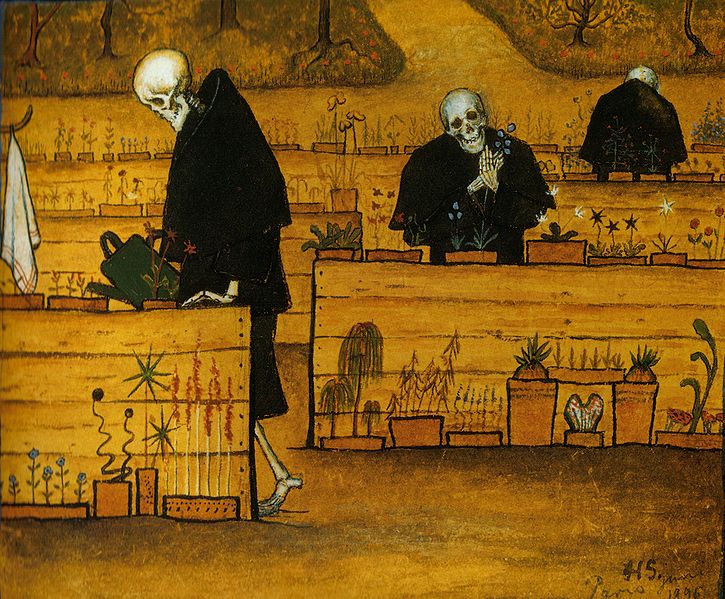
Although it represents the final part of the Blofeld/SPECTRE Trilogy of James Bond novels there is no typical Bondian world domination plot here (cf. the film version) but instead a private estate run by a veritable mad hatter called Dr Guntram Shatterhand who of course turns out to be none other than Bond’s aforementioned arch-enemy and the murderer of his bride Tracy Bond in On Her Majesty’s Secret Service (1963). SPECTRE it seems has went the way of the Dodo, which is more realistic than how the evil organisation (and its leader Blofeld) kept coming back film after film (excepting Goldfinger [1964]) between 1962 and 1971 in the Eon Productions Bond film series. The Ernst Stavro Blofeld of You Only Live Twice is a different animal (a mad dog meets an Englishman; Fleming was certainly very clever in his themes!) to what went before and here he can be seen as a veritable mad king (called King Ernst I most likely) and a lunatic ready for the asylum. In English Criminal Law there is in fact something called “the Henry VIII Syndrome” where the defendant goes around lopping people’s heads off (just like Blofeld) as he thinks he is King Henry VIII; it is therefore good grounds for a plea of insanity with the inevitable result of hospitalisation in a mental hospital. Henry VIII of course had two of his six wives beheaded, namely Ann Boleyn (by the sword) and Catherine Howard (by the axe). Blofeld also displays the madness that afflicted King George III for much of his reign (which lasted from 1760 to 1820). Blofeld shouts in German much like the ranting and raving Adolf Hitler in the Führerbunker near the end of World War II when the war was all but lost and he seems equally as much out of touch with reality. Evidence for this comparison consists of the fact that we are for instance told of "that lunatic Hitler scream" from Blofeld in the Garden of Death at one point in the novel. One reads of Nazis escaping to Argentina and Spain at the war’s end but perhaps a few escaped to Japan too? It may be that that was what Fleming was pointing at – that there was a diverse Nazi evil being spread throughout other third countries as a result of such real post-war Nazi SS resettlement organisations as Odessa or Spinne. For the very original idea of the Garden of Death it is possible that Fleming was inspired by the 1896 watercolour painting named 'The Garden of Death' by the Finnish symbolist painter Hugo Simberg (1873-1917):

                                              'The Garden of Death' (1896) by Hugo Simberg.
                                         
It is notable that Blofeld’s plan here is not to hijack a Vulcan bomber and its deadly cargo of two nuclear bombs for a grand ransom (Thunderball [1961]) or to use biological weapons against the United Kingdom (On Her Majesty's Secret Service) but merely to induce the notoriously suicide-prone native Japanese population to kill themselves in ever more eccentric fashion in a “garden of delights” populated by highly poisonous flora and fauna, piranha fish, scorpions, snakes and fumaroles. This garden is the locale where Blofeld goes utterly insane and indeed it is a veritable anti-Eden where the Fall of Man brought about by Adam and Eve’s quest for knowledge is all too evident. It is as if the imaginative horrors of a Brothers Grimm fairy tale or a novel by the Marquis de Sade have somehow come to life in the early 1960s with a little early Swinging Sixties hocus-pocus thrown in for good measure. Blofeld does his rounds of the garden in a full suit of armour as does his companion Bunt (with the grotesque addition of a bee-keeper’s hat) and Fleming seems to be making the point that Blofeld is trying to be a legitimate samurai warrior with all of the code of honour that implies though we the reader see he is woefully inadequate in this role and that he is a mere gaijin, common criminal and definite bounder. The madman Blofeld is nothing more than a mere shadow warrior playing at being a samurai warrior just like children play at being James Bond. Blofeld and Bunt even plan to eventually sell up from Japan and then take their ghastly “death show” on the road in other locations around the world such is their ultimate cruelty, depravity and deeply twisted inhumanity.


In You Only Live Twice there is no world domination master plan but in its stead there is just the mad king Blofeld lopping off people's heads with a samurai sword, years before the serial killer fiction craze of the 1990s (which has of course continued on until the present day) that Blofeld's plan to maximise Japanese suicides in his Garden of Death is akin to. In this sense Blofeld can be seen as a forerunner to that other madman in a Castle of Death, the serial killer ex-actor David Dragonpol in John Gardner’s James Bond continuation novel Never Send Flowers (1993) who lived in the aptly-named Scholss Drache (‘Drache’ being German for ‘Dragon’ as well as Sir Hugo Drax’s real name in Fleming’s Moonraker [1955]) in the Rhineland, Germany. Indeed, there are many interesting connections between both Bond novels, though the Fleming purist might blanch at the idea of Gardner’s  off-beat creation Dragonpol being compared to Fleming’s infamous arch-villain Blofeld! Like Dragonpol with his assassination targets of the good and the great, Blofeld attracts the suicidal Japanese seemingly for his own sick enjoyment and also for the delectation of his squat and grotesque consort Fraulien Irma Bunt. Bunt has the type of wardress face often associated with a Nazi death camp guard and as she is German and of the right age that could well have been her occupation. Fleming may well have drawn inspiration for Irma Bunt from some notorious female Nazi concentration camp guards like Ilse Koch (1906-1967), who eventually committed suicide in prison or ‘The Bitch of Buchenwald’ or Irma Grese (1923-1945), whom the Press called ‘The Beast of Belsen’ during her 1945 ‘Belsen Trial’ for war crimes and whom the inmates also dubbed ‘The Hyena of Auschwitz.’ Grese was found guilty at the trial and executed by hanging in 1945. In any event, Fleming’s contemporaneous readers would have been aware of the allusion to female Nazi wardresses Irma Bunt represented. Bunt (as described by Fleming) also looks a tad like the convicted serial killer Rosemary West.


              George Almond's painting of Ernst Stavro Blofeld in his Garden of Death in Fleming's 
You Only Live Twice (1964).

Of course, Fleming’s novel is as far away from the dire Roald Dahl-scripted 1967 film version as it is possible to get. (Harold Jack Bloom also worked on the screenplay before Dahl was hired and he was credited with "additional story material" as Dahl used some of his ideas in his new script). As the producers Albert R. "Cubby" Broccoli and Harry Saltzman and director Lewis Gilbert were unable to find a castle built near the sea on their recce to Japan (it turned out that the Japanese did not build castles near the sea due to the tsunami risk) they decided to move almost completely away from the Fleming source novel by literally throwing it in the wastepaper bin and starting over again with a topical Cold War Space Race plot.  Meanwhile, the Fleming purist can only hope that You Only Live Twice will at some point in the future be filmed as a new chapter in Bond villainy where evil is seen to have had no other point than glorying in said evil itself. That seems a good theme for a Bond film that could sit very well along with the Bond film villains Karl Stromberg and Hugo Drax (of the films The Spy Who Loved Me [1977] and Moonraker [1979] respectively) who were not interested in money or extortion but rather in creating new worlds in their own inherently evil image, just as it could be said Blofeld did originally with his Garden of Death in Japan. Bunt makes the point in conversation with Blofeld that the world has never seen the like of Blofeld’s Garden of Death before and so too would have Stromberg and Drax had they been interviewed about it following the success of their annihilator schemes. Ian Fleming's other villainous creation Dr Julius No was of course also an influence on the Bond film villains Stromberg and Drax and their nefarious schemes. Blofeld has seemingly single-handedly turned the Godly garden and the Englishman’s dwelling place of a summer day into a dark and grotesque “Disneyland of Death”. In opposition to this perversion of the inherent sacredness of the garden is the fact that the English county of Kent is known as "The Garden of England" (cf. The Garden of Eden?) and this was of course on the side of the angels and was a haunt of Ian Fleming's and was where the majority of his third novel Moonraker was set. Moonraker featured a duplicitous ex-Nazi called Sir Hugo Drax who is based in Kent near the White Cliffs of Dover with his answer to Britain's defence, the “Moonraker” nuclear rocket. The fact was surely not lost on Fleming that he chose this very location given the Battle of Britain and the new British saviour weapon in the arsenal called the the Spitfire aircraft (as well as defences from ‘Operation Sealion’) that saved dear dependable old Blighty in her ‘Hour of Need’. Blofeld selfishly wanted his Garden of Death to be a success just as Stromberg’s wanted his own underwater civilisation at the expense of the rest of the world or that Drax wanted to annihilate the Earth (in a Hiterian Holocaust) and then populate it with a new Super Race of perfect physical specimens of all races. 


                                               You Only Live Twice (1964): US First Edition.
                                       
One can quite easily see (in the Blofeld of the You Only Live Twice novel) the seeds of these truly bizarre and barking-mad characters in some of the Bond villains of the Roger Moore-era Bond films. In this sense, perhaps a bit of the You Only Live Twice Blofeld has rubbed off on some of the cinematic Bond villains that came in the years after Ian Fleming’s death where the screenwriters like Roald Dahl, Tom Mankiewicz and Christopher Wood otherwise turned away from the original Fleming Bond source material when it came to Bond villains and other components. With all of this in mind, one also thinks of Richard Maibaum’s original plot suggestion for The Spy Who Loved Me film to have real-world terrorists blow up the world’s oil fields with stolen nuclear submarines and watch the world burn just for the sheer hell of it. That would have been as close to the Blofeld of You Only Live Twice novel as the Bond films would likely have ever gotten. It was sad indeed that Maibaum’s vision for something “completely different” (as the Monty Python’s Flying Circus gang would have put it) never made it onto the screen. The producer Albert R. “Cubby” Broccoli ruled out going ahead with Maibaum’s script for The Spy Who Loved Me out as being too overtly political for the James Bond film series, although he did like the idea. Of course sections of the recent Skyfall was based at least in part on events near the end of You Only Live Twice where Bond is shot in the head and loses his memory, and for the Fleming enthusiast that was surely a great thing to behold. Indeed, the hotly anticipated release of the twenty-fourth James Bond film Spectre in October 2015 gives the Fleming purist renewed hope that the criminally neglected novel You Only Live Twice, with its mad king Blofeld and his equally mad Garden of Death will finally make the transition from the printed page to the cinema screen.


Dedicated to Sir Miles of AJB007 Forums, with thanks. 
http://www.ajb007.co.uk

Liked this article? Then see the following related article on TBB: 

Ian Fleming's "Thrilling" Inspiration for Roald Dahl's You Only Live Twice (1967) http://thebondologistblog.blogspot.co.uk/2012/08/ian-flemings-thrilling-inspiration-for.html


TBB Article No. 22


© The Bondologist Blog, 2015. 

Thursday, 15 November 2012

Musings on the Literary James Bond and Religion

The subject of the literary James Bond’s religion is a topic rarely touched upon, so here is a short addition to the available literature on the topic. It is my belief that James Bond was a Protestant of some denomination (probably Presbyterian) as he had a father who was Scottish, Andrew Bond, and his creator, Ian Fleming had a Scottish heritage and was brought up in the nonconformist religion. In John Pearson’s 1966 biography The Life of Ian Fleming, there is a very interesting letter Fleming wrote to a minister concerning comments he had made in a sermon about James Bond in 1961:
“…it was now that [Fleming] gave the only sign of concern he ever made about the possible effect that James Bond was having on the world at large. In a letter to the Rev. Leslie Paxton, of the Great George Street Congregational Church, Liverpool, he revealed a side of himself few of his friends can have suspected:
I see from the public prints that the Sunday before last you preached a sermon against the leading character in my books, James Bond, and, presumably by association, against myself.
Now, having had a Scottish nonconformist upbringing and considering myself at least some kind of a sub-species of a Christian, I am naturally very upset if it is thought that I am seriously doing harm to the world with my James Bond thrillers.
Would you be so very kind and let me have a copy, if you have one, of your sermon, so I may see the burden of your criticisms and perhaps find means of mending my ways if I feel that your arguments have real weight behind them.
I can, of course, myself see what you mean about my books, but it occurs to me that you may have put forward profounder arguments than those that are already known to me.
This unlikely mood of death-bed repentance did not last long. Mr. Paxton hastened to assure him that he had never implied that the creator of James Bond had done the world a serious disservice. Reassured, Fleming turned his thoughts once more to making the best of a distinctly strained future.”
This letter has always interested me. I think it shows how Fleming worried about the effect Bond was having and was a sign he was becoming a more puritan, moralistic person by the time he was writing the Bond novels than he had been necessarily in his youth.
Kingsley Amis in The James Bond Dossier, (1965), p. 85 in the Pan 1966 paperback edition points out that:
“The moral content of Mr. Fleming’s work, the values expressed or implied, whether through Bond or directly by the author, have been denounced all over the place. Bernard Bergonzi, in a long piece in The Twentieth Century, March 1958, lamented the ‘total lack of any ethical frame of reference’ in the books. In the course of reviewing On Her Majesty’s Secret Service in the Sunday Times, Raymond Mortimer complained that Bond’s values were ‘both anti-humanist and anti-Christian.’”
Amis goes on to defend Bond’s moral values, stating:
“I should have thought that a fairly orthodox moral system, vague perhaps but none the less recognizable through accumulation, pervades all Bond’s adventures. Some things are regarded as good: loyalty, fortitude, a sense of responsibility, a readiness to regard one’s safety, even one’s life, as less important than the major interests of one’s organization and one’s country. Other things are regarded as bad: tyranny, readiness to inflict pain on the weak or helpless, the unscrupulous pursuit of money or power. These distinctions aren’t excitingly novel, but they are important, and as humanist and/or Christian as the average reader would want. They constitute quite enough in the way of an ethical frame of reference, assuming anybody needs or looks for or ought to have one in adventure fiction at all.”
There are strong religious symbols and themes used throughout the Bond novels. The best example is the reference to Bond as a St. George figure slaying the dragon and rescuing the damsel in distress. For example, Tiger Tanaka says to Bond in You Only Live Twice, “You are to enter this castle of death and slay the dragon within.” This religious reference is also continued in the John Gardner Bond novels. The Bond novels display the classic battle between Good and Evil and the St. George references are an interesting way of highlighting this.
There are also some more direct references to the Christian religion and the Bible throughout the Bond novels and short stories. In Fleming’s The Property of A Lady, set in an auction room, there is the following:
“Bond picked up a wood and ivory plaque that lay on the table. It said:
It is naught, it is naught, saith the buyer.
But when he is gone his way, he boasteth.
- Proverbs XX, 14
Bond was amused. He said so. ‘You can read the whole history of the bazaar, of the dealer and the customer, behind that quotation,’ he said. He looked Mr Snowman straight in the eyes. ‘I need that sort of nose, that sort of intuition in this case. Will you give me a hand?’”
In John Gardner’s Nobody Lives Forever it is revealed that Bond had a very Calvinistic upbringing. John Calvin, of course, was one of the great Protestant reformers. John Gardner himself was a one-time Anglican priest in the Church of England, following his father into the profession until he gave it up, becoming an agnostic for many years until re-entering into the Christian faith a number of years ago. There are references to the Bible and poetry spread throughout his continuation Bond novels. John Gardner's seventh Bond novel Scorpius (1988) has the religious cult ‘The Society of the Meek Ones’, taken of course from one of the Beatitudes of Jesus Christ, ‘The meek shall inherit the Earth.’ Father Valentine in the novel uses an amalgam of faiths to convert disciples to carry out his suicide bombings and assassinations of politicians for him. As a more recent example in Raymond Benson’s first Bond novel, Zero Minus Ten (1997), there is the following passage in Chapter 20, ‘Walkabout’:
“The Aborigines are known for practicing something called a ‘walkabout’, a rite of passage for young and old people alike. They would go out into the bush and stay there for days, weeks, or even months, living off the land, becoming one with the spirits whom they believe live there, and then return. Some say that the spirits act as guides and protect the humans. Bond wasn’t a religious man, but he stood there under the stars and closed his eyes. He breathed deeply several times, concentrating on the silence of the desert.”
From what is known about Ian Fleming’s background, and the fact that he based much of Bond on his own experience, it is fair to say that Bond was probably from a nonconformist Protestant background, as his father was a Scot from Glencoe, and Fleming himself was of this religion. The Protestant religion also fits more with the Anglo-Saxon, British Raj, patriotic elements which were staples of the the pre-war spy thrillers with their support of the British Empire. The Bond novels were partially descended from these pre-war thrillers where the villain was mostly always a foreigner, usually from Europe, and never from within Albion’s shores. As Amis points out in his Dossier, “Throughout Bond’s adventures no Englishman does anything bad. The villains are Americans, Bulgars, Chigroes, Corsicans, Germans, Italians, Jugoslavs, Koreans, Russians, Sicilians, Spanish-Americans and Turks.” “To use foreigners as villains is a convention older than our literature.” The rightness of England has with the attendant notion of the rightness of the Anglo-Saxon mainly Protestant view of England (the "Protestant work ethic" etc.), and this is why I think I can accurately pinpoint what religion Bond was born into and practiced - the Protestant religion and the Scots Presbyterian denomination.

Amen.


TBB Article No. 19.


© The Bondologist Blog, 2006.

Wednesday, 15 August 2012

The Changing Spelling of SMERSH throughout Ian Fleming's James Bond Novels and in the Films

In Ian Fleming’s James Bond novels the Russian phrase Smyert Shpionam (‘Death to Spies’) provides a conjunction to form the name for the Soviet organ of death, SMERSH. A close reading of the Bond novels bears out the fact that the spelling of this Russian phrase varies throughout Fleming’s work. In Fleming’s first novel, CASINO ROYALE (1953) the reader is first introduced to SMERSH through ‘Appendix B, a note on SMERSH,’ which is attached to the file from Head of S for ‘the destruction of Monsieur Le Chiffre.’ This appendix reveals that:


“SMERSH is a conjunction of two Russian words:

‘Smyert Shpionam’, meaning roughly: ‘Death to Spies’.

Ranks above MWD (formerly NKVD) and is believed to come under the personal direction of Beria.”

(‘Casino Royale,’ Ian Fleming, Pan Books Ltd., London, 1965, p. 21)


After Bond was saved from a savage torture and death at the hands of Le Chiffre by a SMERSH executioner, he recalls to his French ally, René Mathis in hospital how the assassin had carved a ‘calling card’ onto the back of his hand:


“‘What’s that?’ asked Mathis. ‘The doctor said the cuts looked like a square M with a tail on the top. He said they didn’t mean anything.’


‘Well, I only got a glimpse before I passed out, but I’ve seen the cuts several times while they were being dressed and I’m pretty certain they are the Russian letter for SH. It’s rather like an inverted M with a tail. That would make sense; SMERSH is short for SMYERT SHPIONAM – Death to Spies – and he thinks he’s labelled me a SHPION. It’s a nuisance because M will probably say I’ve got to go to hospital again when I get back to London and have new skin grafted over the whole of the back of my hand.’” (‘Casino Royale,’ Ian Fleming, Pan Books Ltd., London, 1965, p. 141)


Here Fleming uses the spelling ‘Smyert Shpionam’ which looks more accurately Russian than some of the spellings of the phrase that he later uses.


After successfully completing the ‘Casino job’ Bond, at the wheel of his 1933 4 ½- litre grey Bentley convertible at the start of LIVE AND LET DIE (1954), bitterly recalls that SMERSH assassin who branded him as a spy with a stroke of his stiletto knife in CASINO ROYALE:


“The hand had been fixed, painlessly but slowly. The thin scars, the single Russian letter which stands for SCH, the first letter of Spion, a spy, had been removed and as Bond thought of the man with the stiletto who had cut them he clenched his hands on the wheel.


What was happening to the brilliant organization of which the man with the knife had been an agent, the Soviet organ of vengeance, SMERSH, short for Smyert Spionam – Death to Spies? Was it still as powerful, still as efficient?” (‘Live and Let Die,’ Ian Fleming, Pan Books Ltd., London, 1963, p. 12)


Fleming has made a mistake in this passage by claiming that the scar on Bond’s hand had read ‘SCH’ for ‘shpion,’ when in fact in CASINO ROYALE Fleming tells us that the Cyrillic letters were ‘SH,’ which appears more accurate as these are indeed the first two letters of ‘shpion.’ The next noticeable change to the spelling of the Russian words which form the name SMERSH is that the second word ‘Shpionam’ in CASINO ROYALE has changed its spelling to ‘Spionam’ in Fleming’s second novel, LIVE AND LET DIE. The passage from LIVE AND LET DIE also contains the word ‘Spion,’ meaning spy, but as this is how Fleming has also now spelled ‘Spionam,’ is the reader to conclude that this is an anglicised version of a Russian word which may be more difficult to pronounce with the ‘h’ added to it?


At the beginning of the fourth chapter of Fleming’s fifth Bond novel, FROM RUSSIA, WITH LOVE (1957), entitled ‘The Moguls of Death’ there is another introduction to SMERSH:


“SMERSH is the official murder organization of the Soviet government. It operates both at home and abroad and, in 1955, it employed a total of 40,000 men and women. SMERSH is a contraction of ‘Smiert Spionam’, which means ‘Death to Spies’. It is a name used only among its staff and among Soviet officials. No sane member of the public would dream of allowing the word to pass his lips.” (‘From Russia, With Love,’ Ian Fleming, Pan Books Ltd., London, 1964, p. 27)


The spelling of the Russian words which when contracted form the title SMERSH have changed here again. In CASINO ROYALE the words were spelt ‘Smyert Shpionam,’ then in LIVE AND LET DIE the spelling changed slightly to ‘Smyert Spionam’, and finally in FROM RUSSIA, WITH LOVE it has changed to ‘Smiert Spionam.’ The ‘y’ in ‘Smyert’ and the ‘h’ in ‘Sphionam’ have both been lost gradually through the course of these two subsequent novels. In his ‘Author’s Note’ to FROM RUSSIA, WITH LOVE Fleming writes the following:


“Not that it matters, but a great deal of the background to this story is accurate.


SMERSH, a contraction of Smiert Spionam – Death to Spies – exists and remains today the most secret department of the Soviet government.” (‘From Russia, With Love,’ Ian Fleming, Pan Books Ltd., London, 1964)


Perhaps these changes in spelling can be explained by Fleming either having got the spelling of the name incorrect or by anglicising the name to make it easier to pronounce. Of course, mistakes like this had slipped into the Bond novels before. In DR. NO (1958), for instance, Major Boothroyd replaces Bond’s Beretta .25 with a Walther PPK 7.65 mm pistol, to be worn in a Berns Martin Triple-draw holster. However, in the later novels the holster has become Burns-Martin, a clear spelling error either on the part of Fleming or the publishers.


In Fleming’s seventh Bond novel, GOLDFINGER (1959) there is further confirmation that Fleming has now adopted a new spelling of the Russian words:


“SMERSH, Smiert Spionam, Death to Spies – the murder Apparat of the High Praesidium!” (‘Goldfinger,’ Ian Fleming, Pan Books Ltd., London, 1965, p. 66)


When John Gardner took over the Bond mantle as continuation author, his first Bond novel LICENCE RENEWED (1981) made mention of Bond’s experience with the SMERSH assassin of Le Chiffre in CASINO ROYALE:


“In the back of his mind, he remembered, quite clearly, all the circumstances which had led to the plastic surgery, that showed now only as a white blemish, after the Cyrillic letter Щ – standing for SH – had been carved into the back of his hand in an attempt by SMERSH to brand him as a spy.” (‘Licence Renewed,’ John Gardner, Coronet Books, London, 1982, p. 52)


This clearly implies that Gardner believed that ‘Smyert Shpionam’ was the correct spelling of SMERSH’s full name. It could be said that he was just taking the spelling of the Russian phrase ‘Death to Spies’ from the original spelling given in CASINO ROYALE, however.


In THE JAMES BOND DOSSIER (1965) Kingsley Amis reveals the history of the changing names of the real-life SMERSH in Soviet Russia:


“Between 1953 and 1959 Bond’s opponents tended to belong to, or to work on behalf of, a Russian counter-espionage organization called SMERSH (‘a conjunction of two Russian words “Smyert Shpionam”, meaning roughly: “Death to Spies”’). An organization did exist under this name during the Second World War, but was redesignated O.K.R. (Otdely Kontrrazvedki, Counter-intelligence Sections) in 1946. In fact, thanks to the Soviet passion for renaming bodies while leaving their functions much as they were, both SMERSH and O.K.R. were simply two of the various labels successively attached to what had originally (1921) been founded as Special Sections (Osobye Otdely) of the main U.S.S.R. Internal Affairs apparatus, the Cheka […] The Special Sections are presumably still continuing their work, but this has never been concerned with Western agents outside Russia and the territories she has conquered or occupied. Perhaps Mr Fleming was thrown off by the vague and misleading use of the word shpion.” (‘The James Bond Dossier,’ Kingsley Amis, Pan Books, Ltd., London, 1966, pp. 121-2)


Amis clearly believes that ‘Smyert Shpionam’ is indeed the correct spelling, and perhaps the implication that can be taken from this passage is that if Fleming gave a defunct name and an inaccurately defined function to the dark core at the centre of Soviet counter-intelligence, he may also have become confused about the translation of the Russian words. However, Amis seems to get the feeling that Fleming believed SMERSH was still functioning after the war under that title. SMERSH of course did exist under that particular title during World War II and Fleming accurately described its real-life function in the file on the organisation in CASINO ROYALE:


“SMERSH was next heard of when Hitler attacked Russia. It was then rapidly expanded to cope with treachery and double agents during the retreat of the Soviet forces in 1941. At that time it worked as an execution squad for the NKVD and its present selective mission was not so clearly defined.


The organisation itself was thoroughly purged after the war and is now believed to consist of only a few hundred operatives of very high quality divided into five sections” (‘Casino Royale,’ Ian Fleming, Pan Books Ltd., London, 1965, p. 21)


Of course, Fleming was not writing a serious study of espionage services throughout the world when he wrote the Bond novels. As well as SMERSH the functioning role of the Secret Intelligence Service (MI6), with its attendant ‘OO Section’ is of course also inaccurate and fantastical. It could be said that the OO Section bears some resemblance to Fleming’s ‘Red Indians’ in the wartime Special Operations Executive (SOE), which sent British trained agents behind enemy lines to commit acts of sabotage in Hitler’s ‘Fortress Europe.’ Similarly, the Deuxième Bureau (or ‘The Second Office of the State Major General’), of which René Mathis becomes the head in FROM RUSSIA, WITH LOVE, was at a time the old French army’s military intelligence organisation, but not at the time of Fleming’s writing. The Deuxième Bureau was created in 1871, at the time of the Franco-Prussian War in which France was defeated and the German states unified into the new country of Germany. The Deuxième Bureau was charged with the task of informing the French army about the situation of the enemy troops. The Second Directorate of the National Defence Staff, which combined the formerly separate army, navy and air force specialists, would have been the true successor to the Deuxième Bureau. The Second Directorate was certainly influenced by the traditions and doctrines of the Deuxième Bureau, which was France’s Military Intelligence. General Charles de Gaulle, as the leader of the Free French was partly responsible for the post-war shake-up in French intelligence and counter-intelligence. Collaborative Vichy France had dissolved the Deuxième Bureau during the Second World War. The Deuxième Bureau features in Fleming’s CASINO ROYALE, at the end of FROM RUSSIA, WITH LOVE and is mentioned in passing in THUNDERBALL. THUNDERBALL also mentions that there was a Polish Deuxième Bureau before that country’s defeat at the beginning of the Second World War in September 1939. If Fleming had wanted to be strictly accurate and up-to-date with French intelligence, he would have placed Mathis in the Service de Documentation Extérieure et de Contre-Espionnage (“External Documentation and Counterespionage Service”) (SDECE) which existed from 1947 until 1981, well within the boundaries of the timeline of Fleming’s Bond novels. Colloquially known as “The Pool,” the SDECE was replaced with the Direction Générale de la Sécurité Extérieure (DGSE).  Such inaccuracy and sometimes-deliberate concealment of the real facts is the very nature of fiction. Such considerations aside, ‘the Deuxième Bureau’ has certainly got a much more romantic sound to it. 


In the Bond novels of the 1950s Fleming’s villains tended to be working for SMERSH or on behalf of the Soviets in either a sponsored [i.e. Sir Hugo Drax] or freelance capacity [i.e. Dr. Julius No]. The only notable exception to this general rule in the early novels would be DIAMONDS ARE FOREVER (1956) which featured an American crime syndicate (‘the Spangled Mob’), led by the brothers Spang, involved in a diamond smuggling pipeline, which was Fleming’s foray into the territory of American gangsterism. In the Bond novels of the 1960s, however, Fleming averted his focus from the Soviets, as he rightly sensed that there would be changes in the relationship between the Soviets and the Western powers, and he no longer wished to go down that political route. Instead he created the international terrorist organisation SPECTRE (The Special Executive for Counter-Intelligence, Terrorism, Revenge and Extortion) headed by Ernst Stavro Blofeld and introduced it in THUNDERBALL (1961). ON HER MAJESTY’S SECRET SERVICE (1963) and YOU ONLY LIVE TWICE (1964) completed the ‘SPECTRE/Blofeld Trilogy,’ with THE SPY WHO LOVED ME (1962) in between, being loosely a part of what could be called the ‘SPECTRE/Blofeld Quartet’ as in the chapter entitled ‘Bedtime Story’ Bond relates his last mission in Canada on the trail of SPECTRE to Vivienne Michel, the first-person narrator of the novel.


The subsequent films of the novels, beginning with DR. NO, which was released in October 1962, took their lead from Fleming’s change in the composition of his villains and replaced all of the SMERSH and Russian backed villains of the novels of the 1950s with either SPECTRE membership or independent status. As the Cold War thawed slightly in the post-Cuban missile crisis détente after the events of the ‘13 days’ in October 1962 Russia was no longer seen as being in the ‘doghouse’ so much. The Bond films therefore reflected the new political mood, and made international terrorism in the form of SPECTRE the new villainous threat to the world. 


Despite this, SMERSH and the attendant ‘Smiert Spionam’ made three appearances in the Bond films. Firstly, Tatiana Romanova believes that she is working for the good of Mother Russia when she reports to Colonel Rosa Klebb of SMERSH in FROM RUSSIA WITH LOVE (1963), but what she doesn’t know is that Klebb has defected to make her services available to SPECTRE instead. Thus, the producers have avoided making SMERSH the villains, as they were in the original novel and have instead carried on from DR. NO where SPECTRE were the villains of the piece. SMERSH next makes an appearance in Charles K. Feldman’s elaborate spoof of Fleming’s first novel and Bond in general, CASINO ROYALE (1967). However, as SMERSH in the film are responsible for the killing of sixteen KGB agents, and Fleming’s SMERSH was of course a Soviet organisation, SMERSH is here presented as a SPECTRE-type organisation under another name. The silhouetted presentation of SMERSH’s leader, Dr. Noah (a.k.a. Jimmy Bond) adds to the attempt to ape Blofeld as he had appeared in silhouette in the film THUNDERBALL (1965) under a half-closed shutter.


The most important mention of SMERSH, however, is made in a film where they have been disbanded for years. In Timothy Dalton’s first outing as Bond, THE LIVING DAYLIGHTS (1987), ‘Smiert Spionam’ makes its only appearance in the Bond films as a phrase. However, the keen observer will note that the spelling of this phrase has again changed, this time surely due to inaccuracy. The KGB ‘defector’ General Georgi Koskov tells M, Frederick Gray (the Minister of Defence) and Bond at the safe house in Blayden that the new head of the KGB, General Leonid Pushkin was the reason behind his ‘defection.’ Koskov maintains that Pushkin has a new ‘secret directive,’ namely ‘Smiert Spionom,’ which Bond explains to the Minister of Defence means ‘Death to Spies.’ Koskov says that this directive will mean the assassination of British and American agents and that murder will follow murder. At his following briefing from M for the assassination of Pushkin, Bond is shown the brown paper tag that was found near 004’s body. An assassin in the employ of American arms dealer Brad Whitaker had killed 004, and slid a tag with the words ‘Smiert Spionom’ written in black marker pen onto the OO agent’s climbing rope before abruptly severing it. Later in the film, in the scene where Saunders is assassinated by being crushed in the path of an automatic door, Bond finds a blue balloon with the words ‘Smiert Spionom’ again written in black marker pen on it, floating towards him. The scriptwriters (Richard Maibaum and Michael G. Wilson in this case) have obviously used the amended spelling ‘Smiert Spionam’ featured in the novels FROM RUSSIA, WITH LOVE and GOLDFINGER but have mistakenly transcribed it as ‘Smiert Spionom,’ replacing the ‘a’ which was in all three versions of Fleming’s spelling of the Russian word with an ‘o.’


When Bond holds Pushkin at gunpoint in his hotel room, Pushkin says, “‘Smiert Spionom’ was a Beria operation in Stalin’s time. It was deactivated twenty years ago.” It is unclear whether Pushkin is here referring to the ‘real-world’ SMERSH or the SMERSH of the ‘Bond universe.’ If he were referring to the ‘real-world’ SMERSH, then as it was deactivated in 1946 and Pushkin is speaking in 1987, it would have been more historically accurate for him to say that it was deactivated forty years ago rather than twenty. However, if he is referring to the ‘Bond universe’ SMERSH of the Fleming Bond novels it is still actually thirty years before 1987. In THUNDERBALL we are told that SMERSH disbanded in 1958 in the list detailing the SPECTRE membership, therefore SMERSH was not disbanded in the time of Stalin’s leadership [he died in March 1953] but during the leadership of his immediate successor, Nikita Khrushchev:


“three former members of SMERSH, the Soviet organization for the execution of traitors and enemies of the State that had been disbanded on the orders of Khrushchev in 1958, and replaced by the Special Executive Department of the MWD…” (‘Thunderball,’ Ian Fleming, Pan Books Ltd., London, 1963, p. 52)


General Pushkin’s comments in THE LIVING DAYLIGHTS about Beria heading the SMERSH operation are true to the ‘Bond universe’ as in CASINO ROYALE Fleming had wriiten in the dossier on SMERSH:


“Ranks above MWD (formerly NKVD) and is believed to come under the personal direction of Beria.”


Lavrenty Pavlovich Beria, whom General Pushkin claims originated the ‘Smiert Spionom’ operation, was indeed the director of the Soviet secret police, a forerunner of SMERSH called the People’s Commissariat for Internal Affairs (NKVD), from 1938 to 1953, and he played a large role in the purges of Stalin’s opponents. Soon after Stalin’s death in March 1953 Beria, as one of the four deputy prime ministers and as Minister of Internal Affairs, attempted to use his position as chief of the secret police to succeed Stalin as the sole dictator of the Soviet Union. By July 1953 he had been defeated in this aim by an anti-Beria coalition. He was then arrested, deprived of all his government and party posts and convicted of being an “imperialist agent” and of conducting “criminal antiparty and anti-state activities.” He was executed after his trial in December 1953. In Fleming’s FROM RUSSIA, WITH LOVE there is a telling reference made to Beria. Fleming describes the scene inside SMERSH headquarters at No. 13 Stretenka Ulista:


“On the walls are four large pictures in gold frames. In 1955, these were a portrait of Stalin over the door, one of Lenin between the two windows and, facing each other on the other two walls, portraits of Bulganin and, where until January 13th, 1954, a portrait of Beria had hung, a portrait of army General Ivan Aleksandrovitch Serov, Chief of the Committee of State Security.” (‘From Russia, With Love,’ Ian Fleming, Pan Books Ltd., London, 1964, pp. 27-8)


In the following chapter there is more information given on Beria:

 “Serov, A Hero of the Soviet Union and a veteran of the famous predecessors of the MGB – the Cheka, the Ogpu, the NKVD and the MVD – was in every respect a bigger man than Beria. He had been directly behind the mass executions of the 1930s when a million died, he had been meteur en scene of most of the great Moscow show trials, he had originated the bloody genocide in the Central Caucasus in February 1944, and it was he who had inspired the mass deportations from the Baltic States and the kidnapping of the German atom scientists who had given Russia her great technical leap forward after the war.


And Beria and all his court had gone to the gallows, while General G. had been given SMERSH as his reward. As for Army General Ivan Serov, he, with Bulganin and Khrushchev, now ruled Russia. One day, he might even stand on the peak, alone. But, guessed General Vozdvishensky, glancing up the table at the gleaming billiard-ball skull, probably with General G. not far behind him.” (‘From Russia, With Love,’ Ian Fleming, Pan Books Ltd., London, 1964, p. 34)


By providing accurate background information on the various Soviet secret intelligence and military organizations, Fleming can introduce and expand the role of SMERSH as a useful fictional device, and carry his readers along on the fantasy. This fits in with Fleming’s belief in deploying real place names and brand names throughout his novels to make the sometimes more fantastical elements of the plot seem more real. It is a clear sign of Fleming’s skill as a writer that he can use this literary device to invoke such a great amount of verisimilitude. Nikolay Aleksandrovitch Bulganin, mentioned in the quoted passages above, was, for example, the premier of the Soviet Union from 1955 until 1958. The real SMERSH would have fitted into the Russian KGB’s Third Chief Directorate. It had as its chief assignment the maintenance of security within the armed forces and watching for any potential traitors within the military and intelligence services. This was the actual function that SMERSH had carried out during the Second World War, as Fleming rightly noted in the file on SMERSH in CASINO ROYALE. This also fits in with the mention of the ‘secret directive,’ Smiert Spionom of General Pushkin, the head of the KGB, referred to by the ‘defecting’ General Koskov. The KGB, or Komitet Gosudarstvennoy Bezopasnosti (“Committee of State Security”) was the last of the major Soviet intelligence services created. Its role resembled the American CIA and the FBI combined with the British Secret Intelligence Service (MI6). The KGB was ordered into three directorates. The First Chief Directorate was charged with carrying out counter-intelligence missions to maintain internal security. Fleming’s description of SMERSH would have probably fitted more aptly into the Second Chief Directorate, as it was responsible for foreign intelligence and had a wide variety of subsections dealing with different geographical areas and specific functions, such as that of psychological warfare. By making Colonel General Grubozaboyschikov (‘General G.’) the Head of SMERSH and Army General Ivan Aleksandrovitch Serov the Chief of the Committee of State Security (i.e. Beria’s old job), Fleming is acknowledging that there was not one centralized Soviet organ of counter-espionage and terror like SMERSH, but actually a competing network of military and secret counter-intelligence organizations under many different titles. Fleming was clearly aware of the labyrinthine nature of Soviet intelligence and the ever-changing series of names for organizations with much the same role as their predecessors. Fleming explained away some of these complexities in Soviet counter-intelligence in his Bond novels by saying that SMERSH ranked “above MWD (formerly NKVD)” in CASINO ROYALE.


As an interesting endnote the new spelling of Smiert Spionom for SMERSH used in THE LIVING DAYLIGHTS is itself actually incorrectly spelt in the section on the film in Virgin Film’s BOND FILMS (2002). In the entry for THE LIVING DAYLIGHTS under the heading ‘In The Real World’ the history of SMERSH as a real-life organisation is briefly outlined:


“Koskov terms his operations against British agents Smiert Spionem, the Russian for ‘Death to Spies’. When questioned General Pushkin claims that Smiert Spionem is an abandoned operation dating ‘from Stalin’s time’.


He is correct, as in 1943 this phrase, contracted to SMERSH, became the new name given to a new Soviet military counter-intelligence service. The organisation was disbanded in 1946, although there are countless examples – including the use of the name on official paperwork – of Soviet personnel referring to themselves as working for SMERSH into the mid-1950s.


SMERSH’s responsibilities included the internal security of the Russian state, and its official duties were roughly equivalent to those of MI5 in Britain, although its unsavoury working methods invite comparisons with the Gestapo. SMERSH became infamous in the West for its actions in the satellite communist countries of Eastern Europe, especially Germany, immediately after World War Two. Ian Fleming used a fictionalised version of the organisation as the main adversary of the literary Bond. SMERSH agents appear in the novels Casino Royale, Live and Let Die, Moonraker, From Russia with Love, Doctor No and Goldfinger.” (‘Virgin Film: Bond Films,’ Jim Smith and Stephen Lavington, Virgin Books Ltd., London, 2002, p. 220)


In the same book in the section on the 1967 spoof version of CASINO ROYALE under the heading of ‘The Opposition’ there is another description given of SMERSH:


SMERSH: SMERSH were the villains of Fleming’s earliest Bond novels, including this one. In those it was – as in reality – a branch of the Russian Secret Service whose name was a contraction of the Russian for ‘Death to Spies’ – Smiert Spionem (see The Living Daylights). Here SMERSH is presented as an international criminal organisation more like SPECTRE than anything else. Presumably SPECTRE was avoided in order to prevent Kevin McClory becoming involved in the murky legal quagmire surrounding this project.” (‘Virgin Film: Bond Films,’ Jim Smith and Stephen Lavington, Virgin Books Ltd., London, 2002, p. 71)


By incorrectly labelling SMERSH as derived from the Russian phrase ‘Smiert Spionem’ instead of the spelling Smyert Shpionam used in the novel of CASINO ROYALE on which the spoof is ‘suggested,’ the writers of BOND FILMS have clearly become confused with the incorrect spelling used in THE LIVING DAYLIGHTS film, namely that of Smiert Spionom, which is evidently derived from Fleming’s later adapted spelling of the phrase, Smiert Spionam, used in the later novels which feature SMERSH, namely FROM RUSSIA, WITH LOVE and GOLDFINGER. The writers incorrect spelling of the Russian phrase is therefore not just a one-off confined to the incorrect copying of the spelling used in THE LIVING DAYLIGHTS film, but also to refer to the spelling of the phrase in Fleming’s novels. This confusion over the spelling of the Russian for ‘Death to Spies’ aptly illustrates the complexities surrounding the phrase’s use throughout the whole literary and cinematic Bond canon, and even in Bond commentaries and criticism.


According to a source on the Internet, the phrase from which SMERSH actually derives its name is, in Russian, “C myert shpionam!” and this was the motto of the NKVD, a forerunner of the KGB, officially known as “Voyenna Kontra Razvedka” (Military Counter-Intelligence). As the poster “Jevez” explains on the file on SMERSH on the Bond website ‘Universal Exports’:


“The word, “shpionam” is both the plural (“shpion” is the singular), and has the case-ending which denotes its use as the object of a preposition. Since no preposition occurs immediately prior to the word “shpionam”, it is understood that the preposition “to” is intended. Hence, the motto has a translation of “with death to spies”. When it is spoken in Russian, it is said so quickly that, to non-Russian trained ears, it appears to sound like “smyert shpionam”, and that is how Fleming wrote it. He wasn’t alone in that, as both our CIA, and the British Ministry of Intelligence listed the radical branch of the VKR by that name. It was a very real organization, until the fellows from SMERSH got a little out of hand and began killing foreign spies in wholesale lots – very much against the typical method of operation of intelligence units on both sides of the Iron Curtain. Both the CIA and the MI began massive retaliations, until Khrushchev kicked up a fuss about it. When told by our ambassadors what was actually going on, he ordered the VKR entirely disbanded, immediately.”


This seems to fit with the theory expounded above that Fleming might have anglicised the spelling of the Cyrillic phrase meaning ‘Death to Spies’. It could also be that he misheard it or read a report in which it was spelt “Smyert Shpionam.”  A Greek monk, now called St. Cyril (who features as a p[lot point in the 1981 film FOR YOUR EYES ONLY) who went over the Caucasus Mountains to bring the gospel of Jesus Christ to the peoples there, created the Russian, or Cyrillic alphabet. The monks that went there found that although the people had a well-developed spoken language they had no comparable form of writing. They therefore took the Greek and Roman letters and revised them to represent the different phonetic sounds of the spoken Russian language. This explains why some of the letters in the Russian alphabet look almost identical to the Greek letters. For example, the letter carved by the SMERSH executioner onto the back of Bond’s hand in CASINO ROYALE was the Cyrillic letter for SH – denoting ‘shpion,’ a spy. This letter resembles an inverted M with a tail. As the Russian letter ‘C’ is always pronounced softly and is also a preposition meaning either “to” or “with,” it is easy to see why Fleming mistakenly thought that the three-word phrase “C myert Shpionam!” meaning “With Death to Spies!” was spelt in only two words, “Smyert Shpionam” and meant “Death to Spies.”


Interestingly, Khrushchev’s disbandment of the VKR, which contained the radical branch, called SMERSH at its core, after the reports of the killings of foreign spies, neatly matches Fleming’s passage in THUNDERBALL on the complexion of SPECTRE quoted above where he reveals that SMERSH “had been disbanded on the orders of Khrushchev in 1958, and replaced by the Special Executive Department of the MWD…” It appears that there was a contemporary precedent for Fleming’s decision to disband SMERSH and replace it with the international terrorist organisation SPECTRE, quite beside the fact that Russia was by then (1961) starting to come out of the ‘doghouse’ a little.


Overall then, throughout Fleming’s novels, the continuation novels and the films, there have been four separate spellings of the Russian for the phrase ‘Death to Spies,’ with no real indication as to why changes in the spelling of the phrase were made or which spelling is taken to be the most accurate, although the spelling ‘Smiert Spionam’ turns up most throughout the novels, despite being spelt incorrectly in the film of THE LIVING DAYLIGHTS. All of the confusion over the accurate spelling of the phrase that gives its name to SMERSH may have in fact been down to Ian Fleming’s initial mishearing and misspelling of the words. The history of the spelling of the Russian phrase in the Bond novels, films and film guidebooks certainly reveals some interesting and unexplained inconsistencies. 


TBB Article No. 12


© The Bondologist Blog, 2007.